
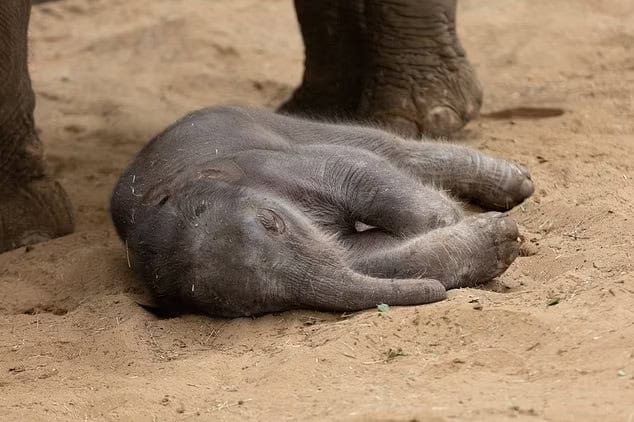
Whipsnade Zoo in Bedfordshire has captured the first steps of a newborn endangered Asian elephant calf.
The calf, born to 13-year-old Donna, arrived on Monday, with the other four females close by during the birth.
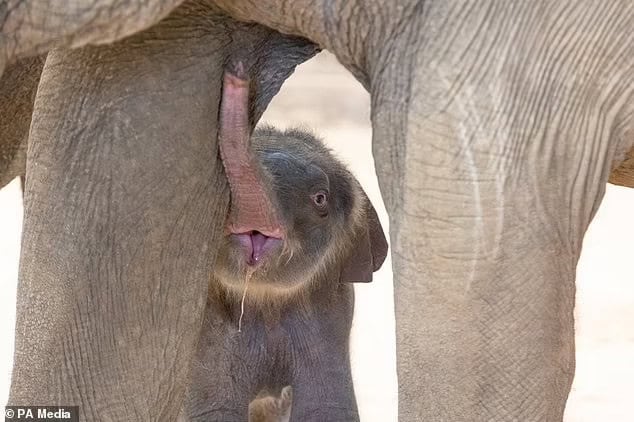
Initially slow to feed from her mother, the calf soon demonstrated a determined nature. She persistently followed Donna around until she could latch on and nurse properly. Zookeepers described the newborn as “milk-drunk” after her first successful feeding.
Mark Howes, Deputy Team Leader of Elephants at the zoo, expressed the team’s excitement over the birth. “Calling this a success is an understatement.
It’s a major achievement for Donna, the herd, and Asian elephant conservation,” he said.
The calf’s birth marks an important milestone in the European-wide breeding program for endangered Asian elephants.
Zoo staff were able to witness the birth via hidden cameras. Howes shared that Donna’s mother, Kaylee, played a pivotal role by guiding Donna through the birth process. She broke the baby’s amniotic sac and helped clear space for the newborn to stand for the first time.
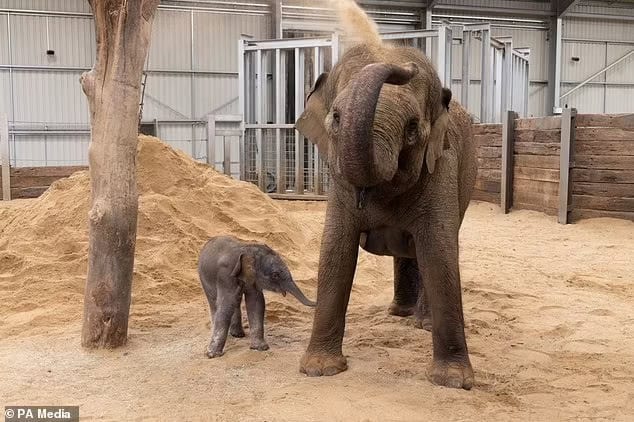
This newborn is the third generation in a matriarchal line at Whipsnade Zoo, and she will be nurtured by her mother, grandmother Kaylee, and the other members of the herd, including her ‘aunts’ and ‘cousins.’
Asian elephants are listed as endangered by the International Union for Conservation of Nature (IUCN). The World Wildlife Fund (WWF) estimates that fewer than 52,000 Asian elephants remain in the wild.
Their natural habitat has shrunk to just 15% of its original range, with countries like Vietnam and China hosting critically low populations, with less than 250 wild Asian elephants in China.
Smaller than their African counterparts, Asian elephants have smaller ears and distinctive pink or yellow markings on their face, ears, and trunk. Their coloring ranges from dark grey to brown.
Howes emphasized the importance of conservation work at ZSL, the charity that manages Whipsnade Zoo.
“We’re one of the few organizations committed to protecting all three elephant species—Asian, African, and African forest elephants,” he noted. “Our herd actively advances our conservation efforts, from helping us develop new technologies to educating zoo visitors.”
Visitors can now see Donna and her newborn calf at ZSL Whipsnade Zoo’s Centre for Elephant Care, open to the public starting Wednesday.
Read more Elephant News.


