
Growing up in southwestern China, Ma Mingliang rarely encountered wild elephants due to centuries of hunting and deforestation that nearly wiped them out. Now, at 42, as the village chief, Ma must barricade his community to keep these animals away.
Over the past year, a herd of Asian elephants has captured the nation’s attention as they embarked on an unusual journey, moving hundreds of kilometers north through farms and cities from their typical habitat in Yunnan province.
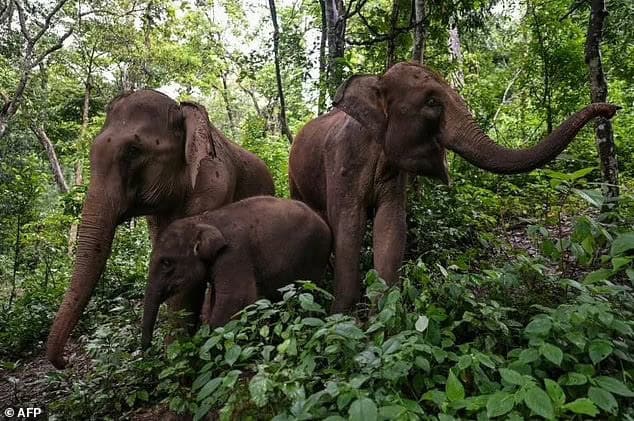
In the elephants’ home region near the Myanmar-Laos border, their presence has become an everyday challenge.
With the elephant population recovering, they are being pushed into shrinking habitats, leading to more frequent clashes with humans.
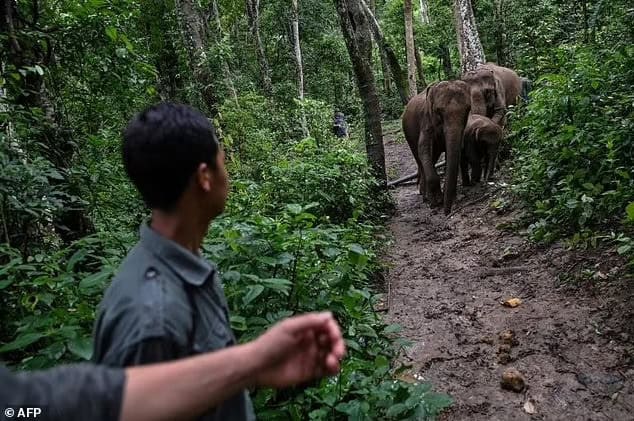
This tension is evident in Ma’s village, Xiangyanqing, in Xishuangbanna, a subtropical area where most of China’s elephants live.
The village, perched on a hillside, is encircled by a steel fence to keep the animals out, with signs promoting peaceful coexistence between humans and elephants.
However, despite these barriers, the elephants often manage to enter, prompting villagers to lock themselves inside until the animals leave, usually after raiding their gardens.

“Things were peaceful before, but now we face conflict,” Ma remarked.
Ironically, the rise in elephant numbers results from successful conservation efforts. Once nearly extinct in China, the population in Xishuangbanna has grown from around 150 in the 1980s to more than 300, thanks to a 1988 hunting ban and protected reserves.
These growing herds are not without challenges. Elephants consume up to 200 kilograms of food daily, often targeting local farms. This results in significant losses, with damages reaching about 20 million yuan ($3 million) annually.

Elephants are also responsible for more than 40 deaths between 2013 and 2019, as they can be unpredictable and aggressive, particularly protective mothers or solitary young males.
State media often portrays the elephants, like the 14-member wandering herd, as a sign of China’s conservation success. However, scientists believe habitat loss is a key factor driving the increased conflict.
Efforts have been made to improve safety, including a high-tech monitoring system that tracks elephants in Xishuangbanna and warns communities to stay indoors and avoid disturbing the animals.
Villagers are adjusting to the new reality. Lu Zhengrong, a local farmer, explained that his community once grew crops like rice and corn, but frequent elephant raids forced them to switch to tea and rubber, crops the elephants avoided.
However, this shift is contributing to further habitat loss as plantations continue to expand into elephant territories.
The mystery behind the 14 elephants’ journey north remains unsolved, but scientists like Zhang Li believe habitat fragmentation and competition for food are likely causes. Climate change is expected to worsen the situation, further reducing available habitat.

China is working on a national park system to protect species like elephants, pandas, and tigers. A proposed elephant national park could help in Xishuangbanna, but it would require the difficult and costly task of reclaiming farmland and relocating many residents to connect fragmented habitats.
For now, villagers must coexist with the elephants. “I can’t say we enjoy it,” said Lu. “But we need to find a balance between the animals and us. They deserve protection.”
Read more Elephant News.


