
Often mistaken for swallows or martins, common swifts belong to a distinct family, the Apodidae. Known for their impressive aerial abilities, these birds spend more time in flight than any other species, covering millions of miles throughout their lives.
Quick Facts:
- Lifespan: 5–6 years (average), 21 years (max)
- Size: 16.5 cm (6.5 in) length, 45 cm (17.7 in) wingspan
- Weight: 44.9 g (1.6 oz)
- Family: Apodidae
1. Identifying the Common Swift
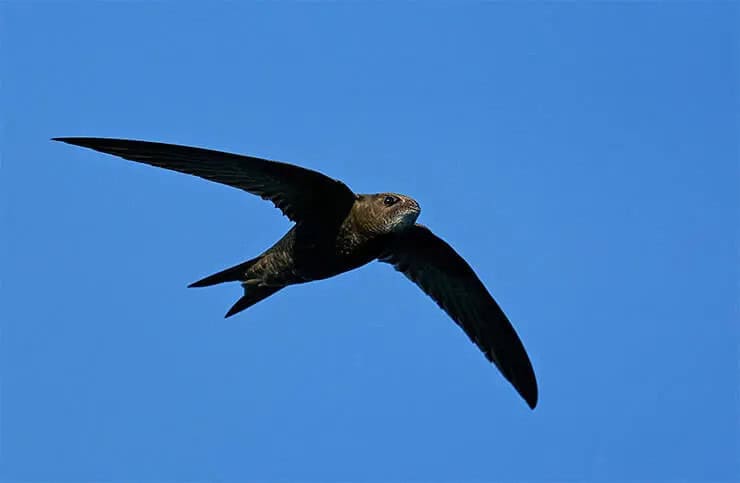
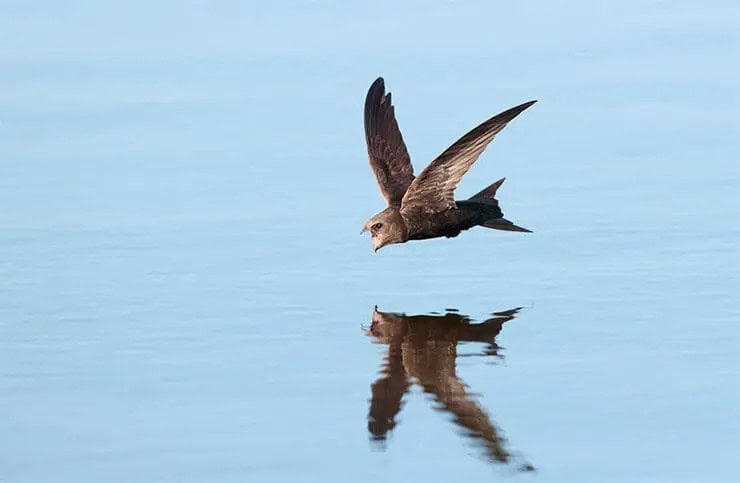
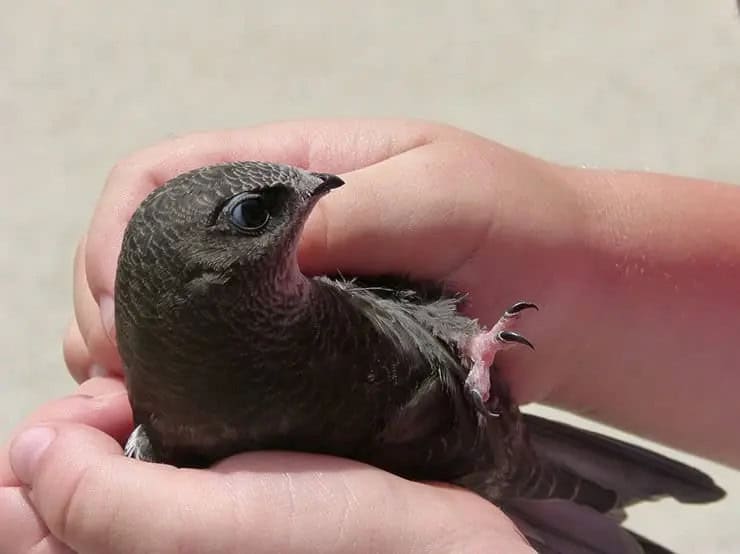
With dark grayish-brown plumage, pale flight feathers, and a white throat patch, common swifts have a unique appearance. They are often mistaken for barn swallows due to their similar shape but are distinguished by their sickle-shaped wings and forked tails.
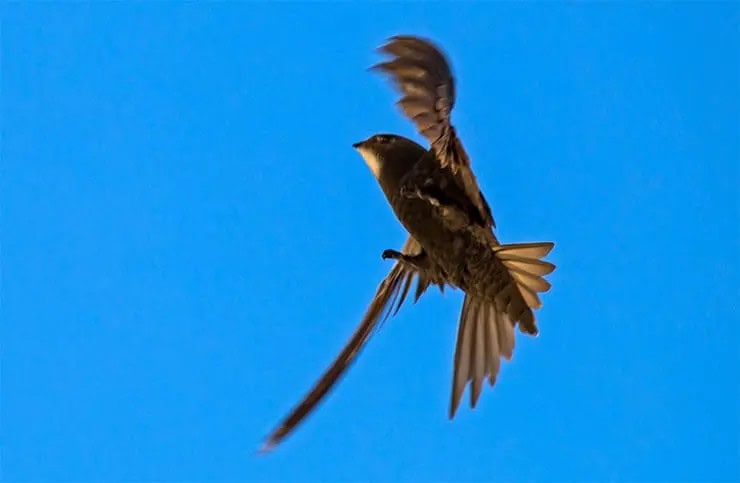
Their small, specialized feet are adapted for perching on vertical surfaces, making ground landings rare. Males and females are visually identical, while juveniles appear darker, with white-tipped feathers.
2. Naming and Origins
The Latin name Apus, meaning “without foot,” references the swift’s tiny feet. While once believed to be related to swallows, swifts are actually closer relatives of hummingbirds and treeswifts, illustrating evolutionary convergence between these species.
3. Vocalizations
Common swifts are known for their loud, piercing calls, especially around dusk. Their calls vary, including a nesting call, a retreat call, and mating calls. During the breeding season, they form “screaming parties,” where flocks soar to around 8,200 feet, a behavior possibly linked to navigation or weather patterns.
4. Social Behavior
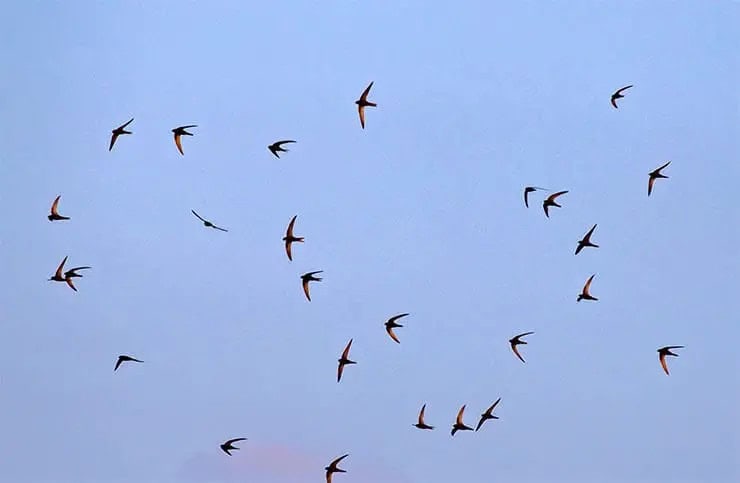
Swifts are social year-round, nesting in large colonies and migrating, hunting, and wintering in flocks.
5. Life on the Wing
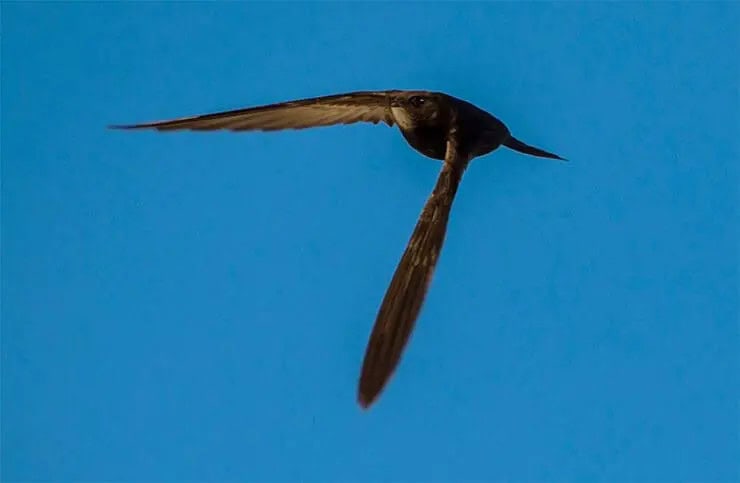
Common swifts can remain airborne for up to ten months, even sleeping, hunting, and mating on the wing. They adjust their flight altitude based on weather conditions and often use warm air currents during migration. Remarkably, swifts can reach speeds of 69 mph.
6. Range and Migration
Swifts have a vast breeding range from Portugal and Ireland to China and Siberia, migrating south to equatorial Africa for the winter. Young swifts may even stay in Africa through their first winter rather than returning north with adult birds.
7. Habitat
During breeding, swifts occupy open, temperate regions with trees or tall structures for nesting. In winter, they inhabit African savannahs, grasslands, wetlands, rainforests, and even deserts.
8. Diet
Common swifts feed exclusively on insects, forming flocks of up to 2,000 birds as they hunt on the wing. Their diet consists of aphids, wasps, ants, beetles, and flies, typically found near marshes and floodplains.
9. Predators and Pests
Swifts are preyed upon by Eurasian hobbies, sparrowhawks, and buzzards, though their flight skills and nesting locations offer significant protection. Swifts are also susceptible to mites and lice.
10. Breeding and Nesting
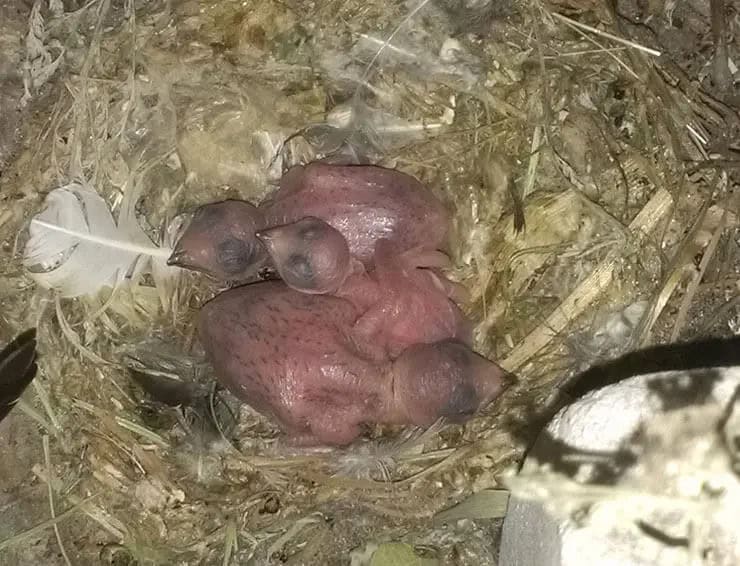
Swifts are seasonally monogamous, forming colonies of up to 40 nests. They often return to the same nest sites each year, choosing tree holes, buildings, chimneys, and cliff crevices. Nest materials gathered mid-flight, include leaves, grass, and flower petals.
The breeding season runs from April to September, with females laying up to four eggs. After an incubation of around 20 days, young swifts fledge by 45 days.
Fun Fact: Swift nestlings can lower their metabolic rate to survive without food for extended periods.
11. Conservation and Ecological Role
With an estimated population of 95 to 165 million mature birds, common swifts play an ecological role in insect control. They are listed as a species of “least concern” by the IUCN, though habitat loss and climate change could impact their populations and migration routes in the future.
Read More Birds
